

Custom Software
There are many ways custom software can help grow your business. Take a deep dive into our most desirable service.


App Development
Expand your business by putting your idea into the hands of users around the world. Custom made, just for you.

Web Design
Get a beautifully crafted website that is designed with mobile users in mind. Fully responsive = better experiences.

Prototyping
Team up with our Ui/UX Designer to create the visual flow of your software. Perfect for ideas that aren't yet fully fleshed out.

Support Plans
Keep your software running after launch, with an AI agent watching around the clock and our developers doing the fixing.
Contact Us
We keep the software we build running after launch, and we take on software other teams built. An AI agent watches your app around the clock and our developers do the fixing.
See the plans


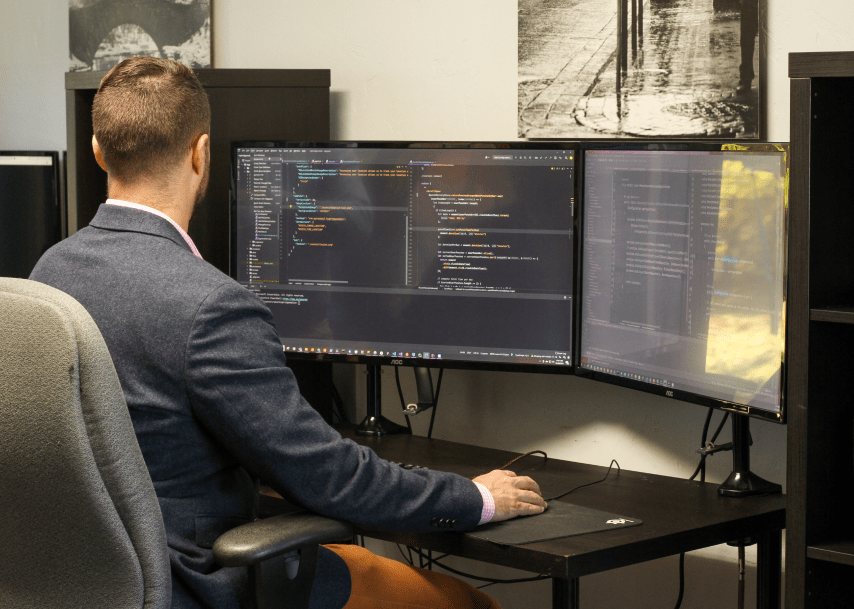
Four things cost money once your software is live. The first is keeping the lights on, which covers hosting, storage, backups and knowing the system is actually up.
The second is keeping it safe. Security patches and dependency updates arrive on their own schedule rather than yours, and somebody has to apply them.
The third is keeping it working, because the services you connect to change, browsers and phones update, and app stores change their rules.
The fourth is keeping it useful, which is the small improvements a product collects once real people are using it every day.
Only the last one is optional. The first three accrue whether or not anyone is looking after them, and that is what a support plan is really for.
The question is not how much support to buy. It is whether you are still building the product or running it.
You are adding features on a regular cadence.
The product is live and it needs to stay up.
If you are doing both, we quote the development work separately and put a support plan underneath it. That is cheaper than paying a retainer large enough to cover both.
| Core | Plus | |
|---|---|---|
| Monthly | $1,500 | $2,400 |
| Agent watching and triaging | Around the clock | Around the clock |
| Response on critical issues | Same business day | Four hours, 7am to 7pm Central |
| How you reach us | Shared Slack or Teams channel | Shared Slack or Teams channel |
| Reporting | Monthly | Monthly, plus a quarterly planning call |
| Development work | Up to 10 hours a month | Up to 16 hours a month |
| Sized for | A normal month of upkeep on one live application | A normal month of upkeep on several applications or surfaces, or on software that takes payments |
Both plans include security patching, dependency updates, backup checks, error monitoring, hosting oversight and the small fixes and content changes that come up in a normal month.
Most months on a live application take two to four hours of development work, so the monthly allowance is headroom rather than a budget to spend down. Core covers up to 10 hours and Plus covers up to 16. If a month runs beyond that we keep working and tell you where you stand, and nothing goes past 12 hours on Core or 20 on Plus without your approval.
New features, new integrations and anything that changes how the product works are scoped and quoted separately, because that is building rather than upkeep. If your months run consistently near the allowance, we will tell you and recommend the larger plan instead of letting it drift.
Nights and weekends are billed at 1.5x when a person is genuinely needed, which is rarer than you would expect, because the agent handles the watching.
The value is in the rules and runbooks we write for your software specifically, so every account starts with a one-time build.
| Scope | What's involved | One-time |
|---|---|---|
| Straightforward | One app, standard monitoring and error tracking, email or ticket intake | $2,500 |
| Standard | Several services, severity rules written for your account, runbooks for known issues, Slack or Teams intake | $4,000 |
| Complex | Multiple apps or environments, unusual integrations, compliance requirements | From $6,000 |
The first job is watching. The agent follows errors, crashes, failed jobs, uptime, log patterns and security advisories for the libraries your app depends on. That part runs around the clock, which is the piece that is expensive to staff with people.
The second job is triage. When something comes in, whether from monitoring or from an email or a message in your channel, it sorts the severity against rules we write with you and groups the duplicates. Then it gathers what a developer needs, meaning the error, what changed recently, who is affected and whether this has happened before.
The third job is answering what it can. Known issues with documented fixes get a documented answer, and status questions get a real answer from the monitoring data instead of a guess.
The fourth job is escalating properly. Anything critical reaches a person right away with the context already assembled, so the work starts at the fix rather than at "something is broken."
What it doesn't do: it doesn't change your code on its own. It can propose a fix, and a developer reviews, tests, and ships it. It doesn't take destructive action on your data, it doesn't replace your developers, and your information is never used to train a model.
The agent runs in your environment, in your cloud account rather than ours. It has read access by default, and anything that can write or deploy is granted deliberately, logged and gated behind a person's approval.
Your data is never used to train models, and every action the agent takes is logged where your team can see it. You can turn it off whenever you want, and the rules and runbooks we wrote for your software stay yours.
We support software other teams built, including products built mostly with AI tools. It starts with an assessment: we review the code, the security, and the architecture, then tell you plainly what's solid, what needs fixing, and what should be rebuilt.
That assessment becomes the scope for any work needed before a plan starts. It protects you from paying a monthly fee for software nobody has actually looked at, and it protects us from promising to keep something running that we don't understand yet.
Yes. We provide support and maintenance for every project we build, and we'll take on software we didn't build after an assessment. No matter who built it.
It is when experienced developers check the work. AI can write code that runs but has security holes or won't hold up as you grow. We review, test, and fix that before anything goes live.
You do. The code is yours to keep, host, and change.
Tell us what you're running and what worries you about it and we'll get back to you within one business day.
